Subscribe and Access : 5200+ FREE Videos and 21+ Subjects Like CRT, SoftSkills, JAVA, Hadoop, Microsoft .NET, Testing Tools etc..
Batch
Date: Nov 2nd @6:00AM
Faculty: Mrs. Sasmitha (Working as a Lead AI ML Architect with 12yrs of Exp..in AI ML)
Duration: 45 Days
Venue
:
DURGA SOFTWARE SOLUTIONS,
Flat No : 202,
2nd Floor,
HUDA Maitrivanam,
Ameerpet, Hyderabad - 500038
Ph.No: +91 - 8885252627, 9246212143, 80 96 96 96 96
Syllabus:
Agentic System Design & Forward Deployment Engineering Course
Phase 1: AI Foundations
Module 1: Introduction to AI
- AI 4 ML 4 Deep Learning 4 Generative AI 4 Agentic AI
- Supervised and unsupervised learning
- The GenAI landscape: OpenAI, Anthropic, Google, Meta, open source
- Intro to agents, multi- agent systems and the FDE role
Module 2: Deep Learning with ANNs
- Perceptron, MLP and the forward pass
- Activation and loss functions
- Backpropagation, gradient descent and optimizers
- Hyperparameter tuning
- Hands- on with Keras / TensorFlow
Module 3: Transformer Architecture
- RNNs and LSTMs to Transformers
- Tokenization, embeddings, positional encoding
- Self- , multi- head, cross- and masked attention
- Encoder and decoder blocks; text generation
- BERT vs. GPT vs. T5; multimodal overview
Module 4: Hugging Face
- Hub, Models, Datasets, Spaces
- Pipelines: classification, NER, summarization, Q&A, generation
- Running open- source models locally; open vs. closed source
Module 5: Responsible AI
- Prompt injection and jailbreaks (live demos)
- Model theft, data poisoning, PII leakage
- OWASP Top 10 for LLMs; bias and hallucination
- Guardrails and human- in- the- loop
- Governance and EU AI Act basics
Phase 2: Prompt engineering, AIDLC and coding agents
Module 6: Prompt Engineering
- Anatomy of a prompt; zero- , one- and few- shot
- Chain- of- Thought, self- consistency, Tree- of- Thoughts, ReAct
- Role, system and negative prompting
- Structured outputs and JSON mode
- Meta- prompting; prompt → context → harness engineering
- Templates, versioning and testing; anti- patterns
Module 7: AIDLC and Spec- Driven Development
- Vibe coding vs. AIDLC
- AI- DLC phases: Inception, Construction, Operations
- The loop: AI plans and executes, human approves and verifies
- ADLC: building agents as products
- Spec- driven development
- AIDLC for data science; measuring tokens, cost and rework
Module 8: Claude Code and Harness Engineering
- Harness engineering: guides before the agent acts, sensors (tests, hooks) after
- Claude Code (live) : CLAUDE.md, skills, subagents, hooks, plugins, MCP, plan and headless mode
- Reviewing AI- written code safely
Phase 3: LangChain, RAG and GraphRAG
Module 9: LangChain
- Chat models and message types
- Prompt templates, chains, output parsers
- Tool calling
- Chatbots with conversation memory
- Document loaders and text splitters
Module 10: RAG End- to- End
- Embeddings and chunking
- Vector DBs: FAISS, Chroma, Pinecone, Qdrant, pgvector
- Hybrid retrieval: dense + BM25 + metadata
- Rerankers: cross- encoders, Cohere Rerank
- Query transformation; agentic RAG
- Citations, groundedness, reducing hallucinations
Phase 4: Agentic System Design
Module 11: Agentic Design Principles and Patterns
- AI agents vs. agentic AI vs. GenAI
- Workflows vs. agents; human- in- the- loop
- Architectures: router, planner–executor, supervisor–worker, handoff
- Patterns: reflection, tool use, planning, ReAct
- Design principles for production agents
- Architecture trade- offs and ADRs
Module 12: LangGraph
- Nodes, edges, state and reducers
- Tools, conditional edges, subgraphs
- Checkpoints, approval gates, interrupts
- Short- and long- term memory
- Supervisor → worker orchestration; streaming
Module 13: MCP and Safe Tooling
- Hosts, clients, servers; tools, resources, prompts
- Building an MCP server with validated tool contracts
- Secure tool access and allowlists
- Connecting MCP servers to Claude and agent hosts
Phase 5: LLMOps, evaluation and guardrails
Module 14: LLMOps Essentials with Langfuse
- LLMOps vs. MLOps
- Tracing LangChain / LangGraph apps
- Prompt versioning; LLM- as- a- judge scores
- Cost, latency and tokens
- MLflow and Arize Phoenix at a glance
Module 15: Model and Agent Evaluation
- Golden datasets; offline vs. online evals
- LLM- as- a- judge: rubrics, pairwise, pitfalls
- RAG metrics: recall, context precision, faithfulness
- Agent metrics: tool calls, trajectory, task completion
- Evals as a release gate
Module 16: Guardrails and GCP Security
- OWASP threat model; indirect prompt injection
- Input/output guardrails: PII, toxicity, off- topic, hallucination
- GCP basics: service accounts, IAM, Secret Manager
- Red- teaming your system
Recorded Sessions
Module 17: ANN Project: Sentiment Classifier
- Data preparation and text vectorization
- Training, evaluation and inference
Module 18: Neo4j, Cypher and GraphRAG
- Graph vs. relational; nodes, relationships, properties
- Cypher: CREATE, MATCH, MERGE, aggregations, paths
- Knowledge graphs from documents with LLMs
- Neo4j vector index; GraphRAG (vector + full- text + graph)
- “Show evidence + show pathˮ answers
Module 19: DeepAgents
- Planning, sub- agents, virtual file system, detailed prompts
- Middleware; approval on sensitive tools
- Hands- on: a research deep agent
- Debugging; DeepAgents vs. LangGraph
Module 20: Databricks Basics, Unity Catalog and GenAI
- Lakehouse basics: workspace, clusters, SQL warehouses, notebooks
- Unity Catalog: catalogs, schemas, tables, lineage
- Views- only pattern
- Generative AI and agents on Databricks
Module 21: Deploying to GCP Cloud Run
- FastAPI + Streamlit app
- Docker 4 Artifact Registry 4 Cloud Run
Projects
Two capstones built live, plus a recorded third capstone on Databricks.
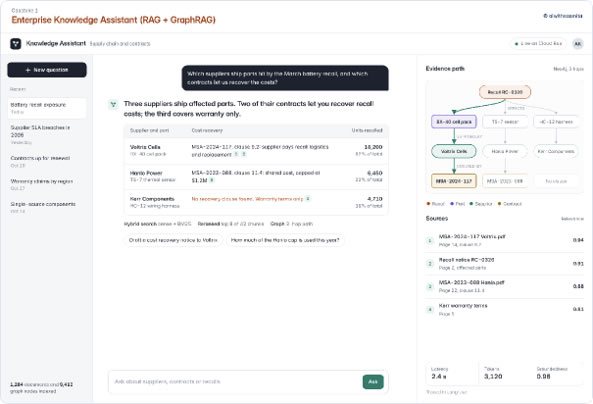
Capstone 1: Enterprise Knowledge Assistant (RAG + GraphRAG)
- Hybrid retrieval with a reranker
- Neo4j knowledge graph with multi- hop Cypher
- Answers with citations and the graph path
- FastAPI + Streamlit chat UI, traced in Langfuse
- Deployed on GCP Cloud Run
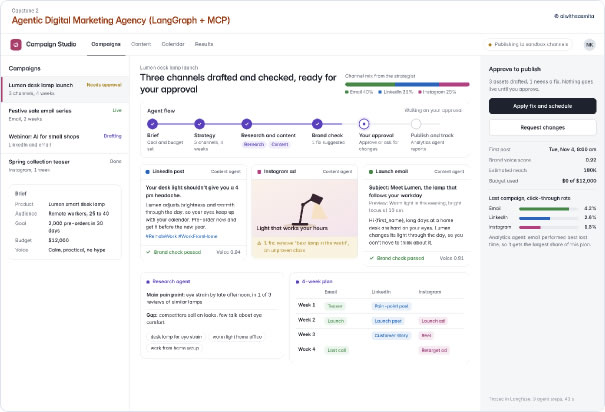
Capstone 2: Agentic Digital Marketing Agency (LangGraph + MCP)
A team of AI agents that runs a marketing campaign end to end, from brief to published content to results, with a human approving before anything goes live.
Project Flow:
1. Marketer submits a brief: product, audience, goal, budget
2. Strategist agent builds the campaign plan and channel mix
3. Research and content agents create posts, email and ad copy in the brand voice
4. Brand- safety agent checks every asset
5. Human approves before anything is published
6. Publish via MCP tools and track; analytics agent reports results and suggests next steps
Built AI- first from a spec (AIDLC) , traced and evaluated in Langfuse, deployed on GCP Cloud Run.
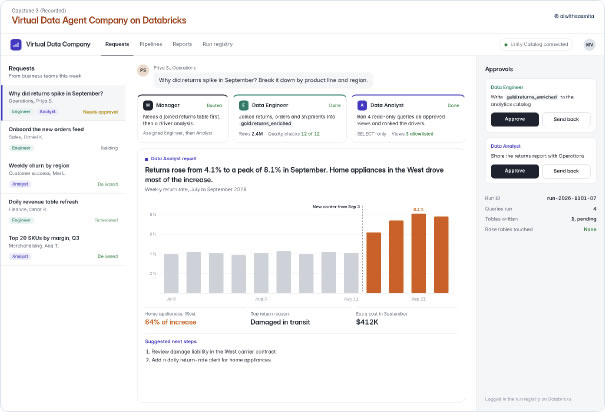
Capstone 3 (Recorded): Virtual Data Agent Company on Databricks
A team of AI agents that works like a small data team: a manager agent routes each request to a Data Engineer agent and a Data Analyst agent.
Project Flow:
1. Business user asks a question or requests a dataset
2. Manager agent plans and routes the request
3. Data Engineer agent ingests, cleans and builds Delta tables in Unity Catalog
4. Data Analyst agent runs Text- to- SQL and finds insights
5. Human approves before data is written or results are shared
6. Report delivered, logged in a run registry
Built with agents on Databricks, governed by Unity Catalog.